
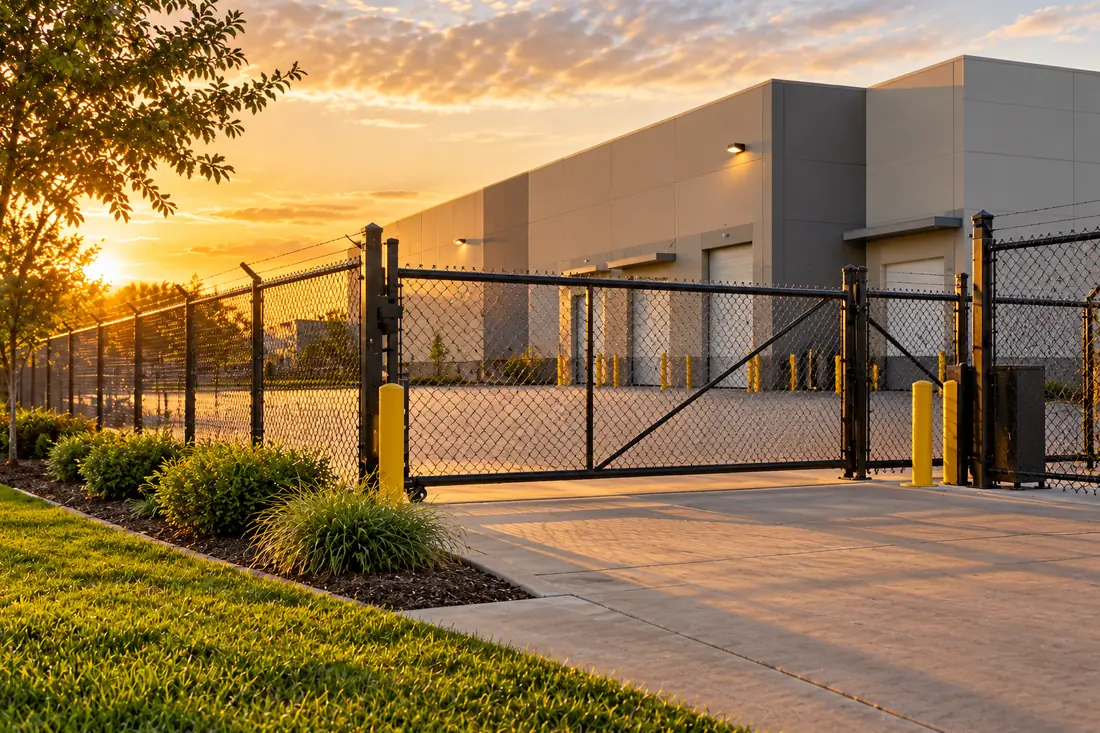
What makes commercial gates worth considering
On a commercial property, the gate is often the most operationally important part of the fence. It may control employee entry, deliveries, service-yard access, equipment movement, pedestrian traffic, or customer-facing vehicle access.
Pecos plans commercial walk gates, drive gates, wrought iron entrances, chain-link gates, sliding gates, swing gates, and automated systems as part of the larger perimeter rather than treating them as isolated accessories.
Traffic frequency matters. A gate used twice a week has different hardware and operator demands than an entrance cycling throughout the workday. The free estimate should reflect how the gate will actually be used after the project is complete.
Best for
- • Commercial service yards
- • Vehicle entrances
- • Employee access
- • Equipment and trailer access
- • Customer-facing business entrances
Options
- • Walk gates
- • Chain-link drive gates
- • Wrought iron entrances
- • Sliding vehicle gates
- • Swing vehicle gates
- • Automated access-control systems
Planning the commercial gates project
Map traffic before placing the gate. Delivery trucks, trailers, forklifts, employee vehicles, emergency access, customer parking, and loading areas can all affect clear opening width and gate location.
Gate posts and frames should be designed for the opening and cycle count. Wide or frequently used gates concentrate load and wear in ways that fixed fence sections do not.
Active businesses also need sequencing. If a gate or perimeter section is being replaced, the plan may need temporary access, after-hours work, staged demolition, or coordination so the site does not lose required security during the project.
What affects the cost?
Commercial-gate pricing depends on opening width, material, frame, posts, footings, hinges or rollers, track, hardware, automation, power, safety devices, access controls, traffic requirements, and site preparation.
A useful proposal separates the gate system from the surrounding straight fence footage so the business can see what is driving the entrance cost.
We'll make the scope clear—including materials, posts, gates, site access, demolition, and any specialized hardware that applies—so you know what's in the estimate.
Care and long-term performance
High-use gates should be inspected on a schedule. Watch posts, hinges, rollers, guides, track, frame alignment, latches, operators, photo eyes, and access-control equipment before small wear becomes a shutdown.
Impact damage should be addressed quickly, especially where a bent frame or post affects security or forces an operator to work against resistance.
Comparing your options
A commercial walk gate is primarily a pedestrian opening. A vehicle gate must account for far greater span, weight, traffic, and turning geometry.
Chain-link gates prioritize practical perimeter control, while wrought iron entrances can provide a more finished customer-facing appearance. Many commercial sites use both in different zones.
Frequently asked questions
Does Pecos build commercial vehicle gates?
Yes. Pecos builds sliding and swing vehicle gates and can plan automated access where appropriate.
Can commercial gates use chain link?
Yes. Chain-link walk and drive gates are practical for service yards, equipment areas, and utility-focused perimeters.
Can a commercial gate be automated?
Yes. Operator, power, safety devices, access controls, traffic frequency, and gate structure all need to be planned together.
Can gate replacement be phased so a business stays open?
Often. The site plan should identify access and security needs before demolition so the project can be sequenced around operations.